An island nobody had warned it about
In 1598, ships from the second Dutch expedition to the East Indies, blown off course by a storm, anchored off a small volcanic island in the Indian Ocean. The sailors named it Mauritius, after Maurice of Nassau, the Dutch stadtholder. Portuguese ships had passed by earlier in the 1500s, and Arab navigators probably knew of it before that, but it was the Dutch who wrote the first detailed descriptions and made the first drawings of the island's strangest resident.
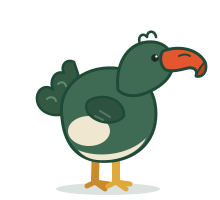
It was a bird about the size of a turkey, heavy and round-bodied, with small stubby wings, a big hooked beak and a curly tuft of tail feathers. It couldn't fly. And, as the sailors found, it didn't run away from people either.
It had no reason to be afraid. For its whole evolutionary history, nothing on Mauritius had ever hunted it.
A perfectly sensible bird in a world with no predators
Mauritius sits alone in the Indian Ocean, about 2,000 km off the coast of Africa, and its only native mammals were bats. There were no cats, rats, pigs or monkeys: nothing that hunted birds on the ground.
The dodo's ancestors were pigeons that flew to the island long ago. With plenty of fallen fruit to eat and nothing to escape from, flying stopped being worth the effort. Over many generations their descendants grew larger, lost the ability to fly, and nested on the ground. Its closest living relative today is the Nicobar pigeon of Southeast Asia. Its closest known relative of all was the Rodrigues solitaire, another flightless giant pigeon from a nearby island, which also went extinct.
So the dodo wasn't stupid, whatever the cartoons say. It was well adapted to its island. The trouble was that its island was about to change very fast.
Not as fat as you think
Many famous paintings were made in Europe, sometimes from overfed captive birds or from other drawings. Researchers working from bones now think wild dodos weighed roughly 10 to 18 kg, and were leaner and more upright than the plump, waddling bird most people picture.
It took less than a century
Sailors did catch and eat dodos, and some journals complain the meat was tough. But most researchers think hunting was not the main cause. The bigger damage came from the animals the ships brought with them, and from what people did to the forest.
- 1598
First detailed accounts
Dutch sailors describe the bird. Mauritius soon becomes a regular stop for ships picking up water and food on the route to Asia.
- 1600s
New arrivals
Rats, pigs, dogs, cats and crab-eating macaques come ashore with the ships. A ground-nesting bird that is thought to have laid a single egg at a time had no defence against animals that raided nests and competed for food.
- 1638
A permanent settlement
The Dutch set up a colony. Forests are cut for timber, including valuable ebony, and cleared for farming, shrinking the dodo's habitat while its eggs and chicks were already under attack.
- 1662
The last widely accepted sighting
Volkert Evertsz, stranded after the ship Arnhem was wrecked, reports catching dodos on a small islet off Mauritius, probably what is now called Amber Island.
- c. 1690
Gone
No one knows the exact date. A 2003 statistical study of the last sightings put the most likely extinction date at around 1693, and very probably before 1715.
How a lost bird became a symbol
The dodo vanished so quickly that very little of it was kept. The best-preserved stuffed specimen, in Oxford, had decayed so badly that in 1755 most of it was thrown away. Only the head and a foot were saved. For a while some people wondered if the bird had ever really existed.
That changed in the 1800s. Naturalists showed that the dodo was a kind of pigeon, and in 1865 a schoolteacher named George Clark found a large number of dodo bones in a marsh on Mauritius called the Mare aux Songes. Skeletons could finally be put together. The same year, Lewis Carroll put a Dodo in Alice's Adventures in Wonderland. It's often said that Carroll, whose real name was Charles Dodgson, saw himself in the bird because a stammer made him introduce himself as “Do-Do-Dodgson”. John Tenniel's illustration fixed the plump, comic image that most people still picture today.
An early textbook case
By the 1830s the dodo was being used as an example of a species wiped out by people, at a time when the idea of extinction itself was still new.
“Dead as a dodo”
The phrase is recorded in print by the 1890s and is still shorthand for something that is completely, permanently finished.
A national emblem
Today the dodo appears on the coat of arms of Mauritius, the island that lost it.
What de-extinction can and can't do
Scientists have recovered dodo DNA from museum remains and sequenced its genome. In 2023, the US company Colossal Biosciences announced a project to bring back a dodo-like bird. In September 2025 it reported that it had grown pigeon primordial germ cells (the cells that become eggs and sperm) in the lab for the first time, and had made gene-edited chickens intended to act as surrogate parents. It also set up an advisory committee in Mauritius that includes the Mauritian Wildlife Foundation.
It's worth being clear about what that means. Any bird that results would be a heavily gene-edited Nicobar pigeon carrying dodo-like traits, not a true copy of the original animal. Many biologists question whether that counts as bringing a species back, and whether Mauritius, which still has rats, monkeys and far less forest, could support it. As of 2026, no such bird has hatched and no date has been announced.
The part already working
Mauritius has some real conservation success stories. The Mauritius kestrel and the pink pigeon, a living relative of sorts, were both brought back from a handful of birds by protecting habitat and controlling introduced predators. That's the less dramatic version of the dodo's lesson.